Wednesday, February 12, 2014

CBEBT and Little Sisters of the Poor Lawsuit Update

Yesterday Christian Brothers Services issued an update on the class action lawsuit that it filed last Fall. It is the same lawsuit in which the Little Sisters of the Poor are plaintiffs. Because a large number of RCRI's subscribers participate in the Christian Brothers Employee Benefit Trust (CBEBT) and have called to ask how the recent rulings affect them, we are re-publishing the informative email so that our members are aware of what effect the recent Supreme Court rulings in the case have on those who participate in the CBEBT.
February 11, 2014

Update on Class Action Lawsuit Challenging the Contraceptive Mandate
 
As many of you may know, in September 2013, Christian Brothers Services (CBS), together with a number of participating employers in the Christian Brothers Employee Benefit Trust (the CBEBT), filed a class action lawsuit in federal court challenging the application of the contraceptive mandate under the Affordable Care Act (ACA) to participating employers in the CBEBT. This lawsuit sought to prohibit the government from applying the mandate to participating employers in the CBEBT, or applying any penalties for failing to comply with the mandate.

On December 28, 2013 the federal trial judge assigned to our case denied our request for a preliminary injunction pending the resolution of the case. We ultimately appealed that ruling to the United States Supreme Court and were granted a temporary injunction by Justice Sotomayor on December 31, 2013. On January 24, 2014, the U.S. Supreme Court granted an injunction to the employer applicants so long as they inform the government that they are "are non-profit organizations that hold themselves out as religious and have religious objections to providing coverage for contraceptive services." That injunction prevents enforcement of the contraceptive mandate against those employer applicants until the 10th Circuit Court of Appeals rules on our request for an injunction.

WHAT THIS MEANS FOR EBT MEMBERS

While the case is pending before the 10th Circuit Court of Appeals, Catholic employers participating in the Christian Brothers Employee Benefit Trust will not be required to provide or arrange for contraceptive coverage.

Because the government agreed at the outset of the case that any preliminary injunction for the named plaintiffs would extend to the entire class, the Supreme Court's order affects nearly 400 Catholic organizations throughout the United States that provide health benefits for their employees through the Trust that are not already exempt from the contraceptive mandate. Our attorneys are currently in discussions with government officials as to exactly what employers participating in the Trust need to do to be covered by the Supreme Court's injunction. We will let you know if the government takes the position that there is anything else that you need to do in order to be protected during the pendency of this case.

CBS is dedicated to providing you with current and up-to-date information on this issue. On February 27, 2014 at 1:00 p.m. Central time, we will be hosting a webinar entitled, "Healthcare Reform Update." Also, within the next few weeks we will be releasing a white paper entitled, "Remaining Faithful: Adhering to Catholic Tenets While Abiding by the Affordable Care Act (ACA)" which will be posted to our website.

CBS supports the basic elements of the ACA and is well aware that dimensions of health care in the United States need improvement. However, we were brought to this action by the federal government, which made numerous exemptions and accommodations as ACA was being implemented, but refused to exempt CBEBT plan participants. Through the Church Alliance, Christian Brothers Services had spent three years attempting to work with government officials on these issues as the regulations under the ACA were being drafted, but the government chose to define a "religious employer" narrowly and to target those employers who do not match their cramped definition. We, together with our fellow litigants, are on the front line in this battle to defend religious liberty for ourselves and our participants.

If you have any questions, please contact John Airola at 800- 807-0100 x 2450 or john.airola@cbservices.org.
Thus, participants in the CBEBT which are not classified as "religious employers" but rather as "eligible organizations" (eligible for an accommodation) should know that they are not required to provide contraception, sterilization, and abortion-inducing drugs to their employees. The injunction protects them (for now) from the $100 per day per employee fine that the ACA imposes upon employers who do not cover all the essential health benefits and are not classified as a religious employer or as eligible for an accommodation.

Indeed, even though a Catholic employer that uses CBEBT may not have an objection to these services or products, Christian Brothers is seeking through this lawsuit to protect its own right to be recognized as a religious organization and to not be required to supply these items. Normally, in situations where there is an accommodation, the insurance company must provide these items to the employees in a separate arrangement. Since Christian Brothers is also a Catholic employer, it also is seeking the same right of refusal. It does not qualify under current ACA provisions as a religious employer nor as eligible for an accommodation.

We will continue to follow the developments in this lawsuit.

Thursday, January 2, 2014

Form 990 Revocation and Procedure for Reinstatement

The IRS has released Revenue Procedure 2014-11 which "provides procedures for reinstating the tax-exempt status of organizations that have had their tax-exempt status automatically revoked under section 6033(j) of the Internal Revenue Code for failure to file required annual returns or notices for three consecutive years."

In recent years we have received from religious institutes and affiliated ministries a number of requests for assistance with unraveling the notices they have received from the IRS with regard to their requirement to file Form 990. A number of organizations have been notified that their tax-exempt status has been revoked, and they find themselves listed on the IRS' list of revoked organizations. This can be devastating for the organization itself as it affects not only the organization's ability to receive tax-exempt donations but also their donors' ability to claim a charitable deduction for their donations. Once their name appears on the list, donors are deemed to have notice of the revocation and can be penalized for claiming a charitable deduction for their donations.

Most of the organizations that contact us in these situations were not required to file a Form 990. This means that they should not have been penalized for non-filing. However, the IRS may not know the reason for the non-filing exemption with respect to your religious institute. If your organization has received notices asking for your Form 990 in the three years leading up to the revocation, your response (or lack thereof) can be important to how the IRS will respond to the attempt to clarify the situation.

Generally, when we are contacted, we help the Treasurer of other business office personnel construct a letter explaining to the IRS that a Form 990 was not required to be filed based on the exemption for the "exclusively religious activities of any religious order" in IRC section 6033(a)(3)(A)(iii). Sometimes the exemption that applies is for an "integrated auxiliary" under IRC section 6033(a)(3)(A)(i). The test for an integrated auxiliary must be satisfied in this latter case and may require additional explanation.

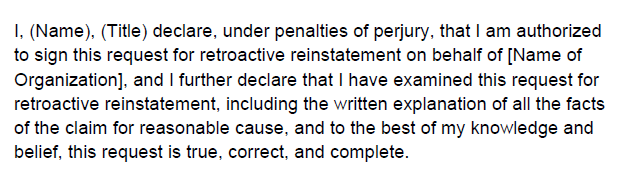
The reason for bringing up this Revenue Procedure is that it contains some specific language that would be wise to adapt and include in your letters when corresponding with the IRS on matters related to Form 990. This is true whether you are responding to a notice asking why you did not file a Form 990 for a given year or if you receive the dreaded notice that your tax-exempt status has been revoked. The pertinent part is in Section 8.06 (pages 7-8) of the Revenue Procedure. Below is the paragraph that the IRS recommends should precede the signature of a request for retroactive reinstatement.
Although you technically will not be asking for reinstatement if you were not required to file a Form 990 in the first place, it is important to indicate that you are aware of the requirements of the regulations that govern the (non-)filing of Form 990.
 
This is an extremely critical area of law, and the success or failure in resolving these IRS notices will affect, among other things, your institute or ministry's ability to not pay taxes on any and all income and your donors' ability to claim a deduction for donations made to your charitable organization(s).

W-2 Reporting of Health Insurance Costs

We have again been asked about whether religious institutes should or must report the cost of health insurance provided to their members on their W-2s. The requirement to report applies only to employers with regard to their employees. For 2013 the requirement remains optional for employers with fewer than 250 employees. So, the answer to "Must we report for 2013?" is a definite "No" if you file fewer than 250 Forms W-2 for employees. An employer filing fewer than 250 W-2s can, but is not required to, report the insurance costs on their W-2s.

Since members are not employees of their religious institutes, we continue to oppose the reporting of member health care costs on the W-2s that you file reporting the FMV of the care you provide to them (for purposes of being included in the Social Security and Medicare systems). If you do report these costs, you will be using a box on the form that is designed for employers to report information on their employees, in contradiction to the historical stance that members are not employees of their religious institutes. For those institutes which have 50 or more members, you could be binding yourselves to the requirement that you must provide government mandated and approved health coverage to your members.

The IRS explains the reason for including the cost for health insurance on the W-2s of employees at http://www.irs.gov/uac/Form-W-2-Reporting-of-Employer-Sponsored-Health-Coverage, stating: "The purpose of the reporting requirement is to provide employees useful and comparable consumer information on the cost of their health care coverage." A second IRS web page (http://www.irs.gov/uac/Form-W-2-Reporting-of-Employer-Sponsored-Health-Coverage) restates this reasoning: "This reporting is for informational purposes only and will provide employees useful and comparable consumer information on the cost of their health care coverage."

The reasons cited by the IRS for including the information on employee Form W-2s--so that employees know how much their health care coverage costs--do not pertain to religious institutes since their members are not employees. Covering the costs of health care is not a perk or benefit of employment for members. Neither civil law nor canon law require religious institutes to provide health insurance to their members. Some members receive coverage through their actual employment outside the institute while others qualify for government-sponsored programs.

Of critical note is the fact that inclusion of health care costs on members' Forms W-2 could indicate your agreement with the assertion that your members are employees. This is contrary to the historical stance that most religious institutes have taken when it comes to the application of federal laws. If you hold your members out as your employees, you could be subject to penalties for failing to provide them with coverage that meets the standards set by the Affordable Care Act. You also could subject yourself to other federal laws that could impose limits on your operations and practices within your sponsored ministries and your religious institute itself.

Lastly, bundling members' Forms W-2 separately from employees' Forms W-2 when submitting them to the IRS can help prevent a misunderstanding. Consider including a note with the members' forms stating that these Forms W-2 are submitted on behalf of members of a religious order who are not its employees, in accord with the election for coverage made under Section 3121 of the Internal Revenue Code.

Wednesday, January 1, 2014

SCOTUS Issues Eleventh Hour Stay Against Enforcement of Contraceptive Mandate

Supreme Court Justice Sonia Sotomayor signed an order last night that temporarily prevents the U.S. government from enforcing the contraceptive mandate against the Catholic organizations that filed a lawsuit earlier this year.


This is the same case in which the Christian Brothers Employee Benefit Trust is a plaintiff. The Order gives the Obama Administration until 10:00 Friday morning (Jan. 3) to file a response with the Court. At that time the Court will likely issue either a retraining order that could remain in place until the case makes its way through the courts, or it could lift the injunction and allow penalties to start accruing against the plaintiffs if they do not comply with the mandate while the case moves through the courts.

The Becket Fund for Religious Liberty, which represents the Little Sisters of the Poor in the law suit, has an announcement on its website reporting on the last minute stay by the Supreme Court.

Stay tuned.

Friday, December 20, 2013

The First Amendment, Catholic Organizations, Same Sex Marriage, and Women's Health

Two recent news stories that could affect Catholic organizations and their freedom to ensure the practice of and adherence to Catholic teaching are causing a buzz on the internet and within the walls of many Catholic organizations.

First is news from Pennsylvania that a state legislator has introduced a bill that would prohibit employers from requiring employees to abide by religious doctrine as a condition of employment. This legislative bill was filed after a non-diocesan Catholic school fired one of its teacher employees who lives in New Jersey. Through a change in that state's law, the employee automatically entered into a civil "marriage" with his same-sex partner. The law changed earlier this year when a court in New Jersey mandated the redefinition of civil marriage to recognize same-sex couples. This meant that the civil union that the school employee and his same-sex partner had entered into in 2008 became recognized as a "marriage" under New Jersey law.

When the school learned of this turn of events, the principal said he had no choice but to fire the teacher because his employment contract said he must abide by Catholic doctrine. The employee asserts that his sexuality was known, that he has been with his partner for many years and that they have frequented school events together. In his mind their marriage did not change anything. The pending legislation is an attempt to prevent religious employers from requiring employees to abide by religious doctrine that is deemed to conflict with civil rights of individuals. In themean time, it is viewed as oppressive and violative of religious freedom by many, both inside and outside of Pennsylvania  and New Jersey.

The second story is from the LA Times and is entitled, "Are Catholic hospitals bad for women's health? ACLU says yes." This article mentions an ACLU report that notes the growth in the number of Catholic hospitals in the ten years from 2001 to 2011. See chart below.

Number and percentage of total acute-care hospitals by hospital type, 2001 and 2011
Original posted on ACLUwebsite

The LA Times article insists that the health of women is endangered when they go to Catholic hospitals because doctors and other staff are hampered by having to abide by Catholic doctrine rather than being concerned about the patient and her health. The article follows on the heels of a lawsuit that was filed recently by the ACLU on behalf of Tamesha Means against the USCCB. The complaint essentially alleges that the Bishops' Conference owes Means compensation because their Church laws prevented Means from getting proper care at a Catholic hospital when she sought care there during atroubled pregnancy. According to the LA Times article:
Everyone knows that Catholic hospitals don’t perform elective abortions.  
Incomprehensibly, Catholic hospitals even fall afoul of the church if they perform an abortion to save a mother’s life. 
But are they negligent if they fail to merely inform a pregnant woman that abortion is the safest option when her health is in danger and her fetus faces certain death? And that if she wants an abortion, she should seek help elsewhere? 
That’s the crux of the issue in a negligence lawsuit filed by the ACLU on behalf of Tamesha Means, a Michigan woman whose local hospital treated her with Tylenol and sent her home twice after her water broke 18 weeks into her pregnancy. The suit alleges that the hospital, the only one within 30 miles of Means' home, did not tell her that her fetus was doomed, nor that inducing labor and terminating the pregnancy was the only way to reduce the risk of a dangerous infection. 
But there is a twist in this case. 
Instead of filing suit against Mercy Health Partners, the Muskegon, Mich., hospital where the incident took place, the ACLU took the unusual step of suing the U.S. Conference of Catholic Bishops, which sets the rules for Catholic hospitals on many aspects of care, including abortion.
Many will recall the controversial news story from Arizona in 2010 when a sister at a Catholic hospital was told by the bishop that she was automatically excommunicated due to her role in deciding that an abortion was necessary for a patient at the hospital. A few months later, the bishop stripped the hospital of its Catholic identity for its defense of the decisions made and the procedures used on the patient. The actions of the bishop remain a controversial topic in many Church circles.

Whether the actions of the Arizona bishop and the hospital staff in Michigan were right or wrong, these events and other high profile Catholic hospital cases will undoubtedly be a part of the big picture that the ACLU attempts to paint of Catholic doctrine and social teaching when and if its case against the USCCB moves forward. Indeed, whether the principal of the Catholic school in Pennsylvania acted appropriately and legally may depend on the party with whom you sympathize.

The question now becomes: Are the First Amendment and women's healthcare services on an unavoidable collision course? And what of the First Amendment versus the rights of gay people? If a collision is inevitable in these cases, will there be any survivors?

Obama Administration Announces Another ACA Waiver for Some Individuals

Late last night or early this morning, depending on where you live, the Obama Administration announced another change to implementation of the Affordable Care Act for some individuals. This time the Centers for Medicare and Medicaid Services announced that individuals whose policies will be cancelled as of January 1 (because they would not be compliant with the ACA) will be able to seek a hardship exemption. Such an exemption will allow them to purchase catastrophic plans that are normally available only to individuals under age 30. Here is the announcement letter that CMS issued.


This latest change in enforcement or implementation comes on the heels of a number of other recent pronouncements by the Administration. After insurers began announcing that they would have to cancel millions of policies for noncompliance with the required coverage for what are called "essential health benefits" in the ACA, millions of people were left with the prospect of being uninsured. These cancellations ignited a firestorm and launched a public relations nightmare for the Obama Administration in light of the Presidents repeated insistence over the last five years that "if you like your health insurance you can keep it." The cancellations proved that assertion to be patently false.
 
In an attempt to fix the problem that the cancellations created, President Obama announced in mid November that insurance companies would be allowed to renew for one more year coverage that did not meet ACA standards. The problem with that attempt at a resolution was that it falls to the states running their own health care marketplace websites to make the actual determination as to which plans can stay in force or not. And two states with the largest populations--New York and California--were among the 22 states that have said that they will not allow plans to be renewed if they do not mee the requirments of the ACA.
 
The Administration also extended the deadline by which individuals have to enroll in order to be eligible for coverage on January 1, 2014, from the original date of December 15 to December 23, 2013. This one-week extension was meant to compensate for the delay caused by the error-plagued rollout of the healthcare.gov website on October 1. In addition, the Administration recently asked insurers to extend the date by which individuals can make their first payment to January 10, 2014, while making the coverage retroactive to January 1. This pronouncement two days ago got little notice in the media since it came in the middle of a week of last-minute Christmas shopping. The 10-day extension is likely to affect only a handful of people who take advantage of it while confusing others who think it means they can wait until January 10 to enroll.
 
So, this latest pronouncement of a hardship exemption for cancellees seems to be yet another attempt to convince individuals whose policies have been cancelled to enroll in the marketplace. However, it could create even more logistical nighmares across the board -- for those who run the exchanges, for insurers who have fewer people paying for coverage, for consumers who do not understand their options, and for those with serious health problems who get a hardship waiver. What these purchasers of catastrophic plans are likely to discover is that these plans cover very little when they go for medical treatment, and they require high up-front costs before coverage kicks in for essential health benefits.
 
If you are interested in catastrophic coverage and want to see a list of catastrophic plans available in your area, go to https://www.healthcare.gov/catastrophic-plan-information/.


Thursday, December 19, 2013

Are Employer-Provided Life Insurance Premiums a Taxable Fringe Benefit?

Does your religious institute or a sponsored ministry pay premiums for life insurance for its employees, in whole or in part? Did you know that the portion that the employer pays is a fringe benefit to the employee and may be taxable under the Internal Revenue Code? IRS Publication 15-B (pp. 11-14) discusses fringe benefits and requirements of -- and exceptions to -- taxation. (See excerpt from Pub 15b below.)


If you discover that you and your employees should be paying taxes on this fringe benefit, consult with your payroll department and ask them to help assess the situation. The higher an employee's income and age, the higher the tax liability is likely to be. You may also want to notify your employees that this perk is a fringe benefit and that taxes may have to be withheld.

If there is a tax liability, Medicare and Social Security taxes are required to be withheld, while income tax withholding is optional. Pub 15b explains this nuance. Notification of this taxable fringe benefit and its inclusion in income should be sent to employees before the issuance of 2013 W-2s in January of 2014.